


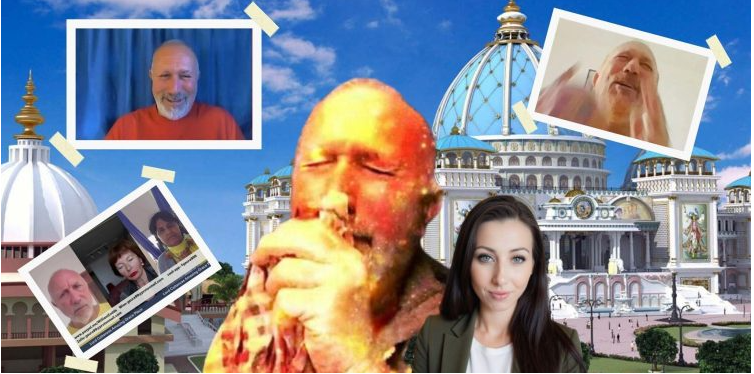
For months, questions have surrounded a man known online as Gaurahari Das, a self-described Hare Krishna teacher whose internet presence has appeared under different names, channels and identities.
His supporters regard him as a spiritual guide. Critics, including former Hare Krishna devotees, have questioned the nature of his authority, his relationship with established Hare Krishna traditions, and the dynamics surrounding his online community.
At the heart of the controversy is a much larger question: what happens when an individual assumes spiritual authority outside the institutions and structures traditionally responsible for recognizing it?
The question becomes even more complicated when that authority is exercised almost entirely online.
Gaurahari’s teachings have reached followers through YouTube broadcasts, online classes and other digital platforms. Former participants and critics have described an unusually intense relationship between the teacher and his most committed followers, while Gaurahari has presented his approach as a continuation—or further development—of Krishna consciousness.
One of his most persistent critics is former Hare Krishna devotee Mike Sandoval, who has used his own online platform to challenge figures and practices within the movement.
The dispute between the two illustrates a new phenomenon in religious life: the internet has made it possible for a teacher to build a community, preserve a body of teachings and cultivate devoted followers without necessarily operating inside a conventional religious institution.
This is the story of that transformation—and of the man behind the online persona.
Before Gaurahari: William Zodda
Before adopting the name Gaurahari Das, the man at the center of this story was known as William Joseph Zodda.
Accounts and publicly available profiles place his origins in New York and later California, before his eventual association with Tucson, Arizona. His own descriptions of his youth portray an unsettled upbringing and a limited conventional educational background.
In a 2023 interview associated with the Hare Krishna Project Podcast, he spoke candidly about his adolescence and early adulthood, describing himself as someone who left school at a young age and spent his early years without a clear sense of direction.
“I quit school when I was 15…”
His account of his spiritual development is unconventional.
Rather than describing a traditional progression through formal religious education, he connects his transformation to a series of extraordinary personal experiences. Among them was an encounter with psychedelic drugs that he describes as a major turning point in his life.
He has recounted taking LSD in San Francisco and subsequently experiencing intense physical and psychological sensations that he interpreted through concepts associated with Kundalini and Indian spirituality.
His account includes descriptions of unusual bodily sensations, visions, an apparent out-of-body experience and an overwhelming sense of connection with God.
He later connected these experiences with his ability to perceive what he regarded as deeper meanings in religious scripture.
For supporters, such experiences may be understood as part of a genuine spiritual awakening.
For critics, they raise a different question: what should qualify someone to claim spiritual authority over others?
That distinction becomes important when examining the evolution of Zodda’s religious identity.
From Personal Revelation to Spiritual Authority
Zodda’s spiritual history appears to predate his association with the Hare Krishna movement.
One organization associated with his earlier activities was Temple of the Heart, which he established in the 1990s. Online profiles have described him using the title “Acarya” or “Acharya” in connection with the organization.
The significance of that title is substantial.
Within many traditional Hindu contexts, an acharya is not simply someone who decides to adopt an impressive religious title. The term can carry associations with teaching, lineage and recognized spiritual authority.
That makes the evolution of Zodda’s religious identity noteworthy.
Before becoming known as Gaurahari Das, he had already developed a model of spiritual leadership outside the major institutions with which he would later associate himself.
His subsequent involvement with Hare Krishna teachings therefore did not represent the beginning of his spiritual identity.
It represented another stage in its development.
Five Years Inside ISKCON
Zodda has described spending approximately five years living within an ISKCON temple after discovering the writings of A.C. Bhaktivedanta Swami Prabhupada, the founder of the International Society for Krishna Consciousness.
According to his own account, the attraction was immediate.
He describes encountering Science of Self-Realization and becoming so convinced by what he read that he wanted to give up his possessions and enter temple life.
But the experience eventually became difficult for him.
He has described struggling with the institutional requirements of temple life, particularly expectations surrounding schedules, discipline and participation in established programs.
In his telling, he eventually left the organization feeling liberated rather than defeated.
He has described the experience in striking terms, comparing his departure to escaping from prison.
That decision would prove important.
He had discovered a religious tradition that gave language and structure to many of the experiences he had already been having. But he had also encountered an institution whose rules and hierarchy he did not ultimately accept.
The tension between spiritual experience and institutional authority would remain central to his later teachings.
Building Something Outside the Institution
After leaving ISKCON, Zodda did not abandon Krishna consciousness.
Instead, he developed his own interpretation of it.
He eventually became known as Gaura and later Gaurahari Das, establishing an online ministry associated with the name Lord Chaitanya’s Amazing Grace Place.
The project combined elements of Gaudiya Vaishnava philosophy with ideas and language drawn from his broader spiritual worldview.
But the most consequential aspect was his understanding of his own role.
Zodda has characterized his work not merely as an independent interpretation, but as something that could carry the tradition forward.
In one recorded discussion, he described his organization as a “successor” and argued that the teachings could be made more complete.
In another context, he spoke about “re-teaching” the tradition beyond the authority of Prabhupada.
Those statements are significant because they go beyond ordinary disagreement with an established religious institution.
They imply a claim to interpretive authority.
That is where the central controversy begins.
Who Has the Right to Define a Tradition?
Religious traditions have always contained reformers.
Teachers reinterpret scripture. Movements split. New schools emerge. Institutions are challenged from within and outside.
The existence of disagreement does not, by itself, establish misconduct.
The important question is how authority is claimed.
Traditional Hare Krishna institutions generally place considerable importance on lineage, initiation, teachers and established systems of transmission.
Gaurahari’s approach appears to place considerably more emphasis on his own experiences and interpretations.
That creates a fundamental difference.
One model says authority is inherited and transmitted through a recognized chain.
The other places greater emphasis on direct spiritual realization and personal understanding.
Gaurahari’s critics argue that the latter approach allows an individual to elevate himself above established checks on religious authority.
His supporters may see it differently: as an attempt to recover spiritual dimensions they believe have become obscured by institutional structures.
Either way, the dispute is not merely personal.
It concerns the very definition of spiritual legitimacy.
The Online Inner Circle
The internet dramatically changed the scale at which Gaurahari could operate.
Instead of requiring a conventional temple with a physical congregation, his community could gather through livestreams, video conferences and online broadcasts.
According to descriptions of the group, a relatively small number of committed followers have participated in his teachings on a remarkably frequent basis.
Gaurahari himself has spoken about conducting classes twice a day, with sessions sometimes lasting several hours.
If accurate, that represents an extraordinary commitment of time.
Such a schedule can produce something very different from occasional religious participation.
It can become a person’s daily environment.
The distinction matters because communities built around intensive participation can develop strong internal bonds. Members become familiar with the same teacher, the same terminology and the same interpretations. The group begins to function as a social world as much as a religious one.
Critics describe this as a potential mechanism of dependency.
That characterization, however, requires careful distinction between intensive religious practice and coercive control. A demanding spiritual schedule alone does not prove that a community is abusive or cultic.
The more important questions concern what happens when members disagree, attempt to leave, or challenge the leader.
The Controversy Over Dissent
This is where former followers and critics have raised some of their strongest objections.
Critics of Gaurahari have alleged that questioning his teachings can result in ridicule, public criticism or hostility from other members of the online community.
Former Hare Krishna devotee Mike Sandoval has been particularly vocal in raising concerns about Gaurahari’s methods and teachings.
Sandoval presents his criticism from the perspective of someone with extensive experience within the Hare Krishna world. His argument is that Gaurahari’s approach departs significantly from recognized Hare Krishna structures and exhibits characteristics associated, in his view, with high-control religious environments.
Gaurahari has rejected such criticisms and has characterized opponents as misunderstanding or resisting his teachings.
This conflict illustrates one of the defining characteristics of online religious communities.
A disagreement that might once have remained within a temple can now become a public spectacle.
A criticism becomes a video.
The response becomes another video.
Followers comment.
Critics respond.
Screenshots circulate.
The dispute becomes permanent.
And the boundary between theological disagreement and personal conflict becomes increasingly difficult to identify.
When a Community Becomes an Echo Chamber
Every close-knit community risks developing an echo chamber.
The problem is especially pronounced online because algorithms reward engagement. Conflict attracts attention. Strong opinions generate comments. Repeated exposure makes familiar claims seem increasingly authoritative.
In a small spiritual community, the effect can be even stronger.
If most members receive their information from the same teacher and the same group of participants, alternative interpretations may gradually disappear from view.
The leader becomes the principal source of information.
The followers reinforce one another.
Critics are treated as outsiders.
And the group develops its own vocabulary for explaining opposition.
This does not automatically make a community a cult.
But these are precisely the dynamics that researchers of high-control groups examine when assessing whether ordinary religious commitment has crossed into coercion.
The distinction depends on behavior.
Can members disagree freely?
Can they leave without retaliation?
Can they maintain relationships outside the community?
Are they encouraged to investigate alternative viewpoints?
Does the leader accept accountability?
And does spiritual authority remain subject to meaningful checks?
These questions are more useful than simply applying the label “cult.”
The Many Names of Gaurahari
Another striking feature of Zodda’s online history is the number of names and channels associated with his spiritual activities.
He has appeared as Gaura, Gaurahari Das, and under longer honorific formulations such as Acarya Srila Gaurahari Das Babaji. Various YouTube channels and usernames have also been associated with his teachings at different times.
There may be innocent explanations for some of these changes.
Online creators routinely establish replacement channels, change usernames or reorganize their content.
But in the context of a controversial religious figure, multiple identities can make accountability more difficult.
An observer attempting to reconstruct someone’s history may have to search through abandoned channels, archived pages and changing usernames.
The result is a fragmented digital record.
For critics, that fragmentation is concerning.
For Gaurahari, it may simply represent the evolution of his ministry.
Again, the evidence matters more than the interpretation.
The Disappearing Channel
One of the most consequential developments in the dispute involved Gaurahari’s YouTube presence.
Critics have reported that a channel associated with him became private, removing previously available material from public view. The current channel associated with the username @gura99 has subsequently been described as largely empty.
The timing has attracted attention because the disappearance occurred amid increased criticism.
But timing alone does not establish motive.
There are many reasons an online creator might make videos private: reorganizing a channel, changing strategy, dealing with copyright issues, reducing exposure, or simply wanting greater control over old material.
Nevertheless, removing a substantial historical archive has an unavoidable consequence.
It makes independent examination more difficult.
Old statements become harder to verify.
Context disappears.
Researchers and critics lose access to primary material.
For anyone investigating a controversial spiritual figure, that creates a legitimate archival problem even if the reason for the deletion remains unknown.
The Question of Coercive Control
The strongest accusations against Gaurahari concern not his theology but his interpersonal methods.
Critics have used terms such as coercive control, high-control group, and micro-cult to describe the environment they believe has developed around him.
Those are serious descriptions.
They should not be treated as established facts simply because they appear in criticism.
Instead, the relevant behaviors need to be examined individually.
Does the leader claim extraordinary spiritual powers?
Does he position himself as uniquely capable of interpreting divine truth?
Does he discourage followers from listening to outsiders?
Are dissenters publicly humiliated?
Does participation consume disproportionate amounts of members’ time?
Are followers pressured to remain loyal?
Are departures punished?
Is information selectively controlled?
Does the leader resist independent scrutiny?
Taken together, such behaviors can be warning signs in any high-control environment.
But each allegation requires evidence.
That distinction is particularly important when discussing identifiable individuals.
The Larger Story
Whatever conclusion one reaches about Gaurahari Das, his story reflects a much larger transformation in contemporary spirituality.
The internet has made it possible for individuals to construct religious communities without traditional buildings or institutional infrastructure.
A person can become a teacher through livestreams.
A follower can become an evangelist through YouTube.
A small group can become a worldwide audience.
And a religious dispute can be documented almost entirely through digital records.
This democratizes religious expression.
It also removes many of the traditional barriers that once stood between a charismatic individual and a devoted audience.
That creates opportunities—and risks.
A person searching for spiritual meaning can now encounter thousands of teachers without knowing which ones possess recognized training, which belong to established traditions, and which have simply created their own systems of belief.
The internet makes discovery easy.
It makes verification much harder.
A Teacher, a Follower, or a Founder?
Perhaps the most interesting question surrounding William Zodda is not whether he should be called a guru.
It is how he came to occupy that role.
His own narrative describes a life marked by instability, unconventional spiritual experiences, experimentation with religious ideas, immersion in ISKCON, rejection of institutional discipline and eventual creation of an independent spiritual ministry.
From William Zodda to Gaura, and from Gaura to Gaurahari Das, each stage added another layer to the identity.
At some point, the seeker became the teacher.
The student became the interpreter.
The interpreter became the authority.
And the authority acquired a community.
That progression is not unique to Zodda.
It is one of the oldest patterns in religious history.
What is different today is the technology.
The modern spiritual teacher does not need to establish a physical temple before attracting followers.
He needs a camera, an internet connection and an audience willing to listen.
The Virtual Guru
The rise of Gaurahari Das therefore raises questions that extend beyond one individual.
What makes someone a legitimate spiritual teacher?
Is personal mystical experience enough?
Does religious authority require lineage?
Can someone reform a tradition without institutional recognition?
When does devoted community become unhealthy dependency?
And who decides where the boundary lies?
There are no simple answers.
The responsible approach is neither unquestioning devotion nor automatic condemnation.
It is scrutiny.
Look at the teacher’s own words.
Compare claims with established sources.
Examine the history.
Listen to former members as well as current supporters.
Distinguish allegations from verified facts.
Pay attention to how disagreement is handled.
And, above all, preserve the ability to walk away.
That last point may be the most important.
A spiritual teacher can offer guidance without demanding ownership of another person’s judgment.
A community can be close-knit without becoming closed.
A tradition can be questioned without collapsing.
And genuine spiritual authority should not require followers to surrender their capacity to think independently.
The controversy surrounding Gaurahari Das and William Zodda is ultimately a case study in what happens when ancient ideas about guru and disciple meet the unlimited reach of the internet.
The physical ashram has become a livestream.
The sermon has become a video.
The disciple has become a subscriber.
And the guru can now speak into thousands of homes without ever opening a temple door.
That makes the question of accountability more important than ever.
Because once spiritual authority moves online, the audience is no longer limited to the people inside the room.
Everyone can watch.
Everyone can question.
Everyone can investigate.
And, perhaps most importantly, everyone can decide for themselves whether the person behind the screen deserves their trust.